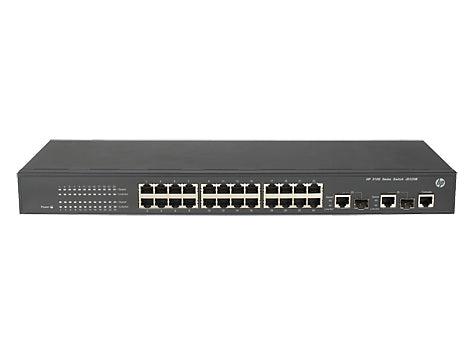
Hewlett Packard Enterprise A 3100-24 v2 EI. Switch type: Managed, Switch layer: L2. Basic switching RJ-45 Ethernet ports type: Fast Ethernet (10/100), Basic switching RJ-45 Ethernet ports quantity: 24, Console port: RJ-45. Full duplex. MAC address table: 8192 entries, Switching capacity: 8.8 Gbit/s. Networking standards: IEEE 802.3,IEEE 802.3u. Rack mounting, Form factor: 1U
HP 3100 EI series switches are Layer 2 Ethernet switches designed for enterprise networks demanding high security and intelligence. They provide 10/100 Mbps downlink and 1000 Mbps uplink Ethernet ports, and serve as access devices for 100 Mbps-to-desktop applications in enterprise networks.
In metropolitan area networks or various industry networks, they connect end users or aggregate client devices with 10/100 Mbps connections, converging at a higher-capacity switch with 1000 Mbps interfaces. Features include advanced Quality of Service (QoS), rate limiting, QinQ (virtual LAN [VLAN]/VPN), SSHv2, Multicast VLAN Registration (MVR), Virtual Cable Tester (VCT), HGMP V2, GARP VLAN Registration Protocol (GVRP), access control list (ACL), media access control (MAC)-IP-port binding, Endpoint Admission Defense, voice and protocol-based VLAN, Internet Group Management Protocol snooping, and Power over Ethernet (PoE).
Features
Quality of Service (QoS) - Broadcast control: allows limitation of broadcast traffic rate to cut down on unwanted network broadcast traffic - Advanced classifier-based QoS: classifies traffic using multiple match criteria based on Layer 2, 3, and 4 information; applies QoS policies such as setting priority level and rate limit to selected traffic on a per-port or per-VLAN basis - Powerful QoS feature: supports the following congestion actions: strict priority queuing (SP), weighted round robin (WRR) queuing, and SP+WRR - Traffic policing: supports Committed Access Rate (CAR) and line rate
Management - Friendly port names: allow assignment of descriptive names to ports - Remote configuration and management: is available through a secure Web browser or a CLI - Manager and operator privilege levels: enable read-only (operator) and read/write (manager) access on CLI and Web browser management interfaces - Command authorization: leverages HWTACACS to link a custom list of CLI commands to an individual network administrator's login; also provides an audit trail - Secure Web GUI: provides a secure, easy-to-use graphical interface for configuring the module via HTTPS
Connectivity - IPv6 (on v2 products): Telnet v6: to allow IPv6 management. DNSv6 Client: for IPv6 host management. SNMPv6: for IPv6 switch management. DHCPv6 Client: for automatic IPv6 address configuration of a switch. - Auto-MDIX: automatically adjusts for straight-through or crossover cables on all 10/100 and 10/100/1000 ports - Flow control: provides back pressure using standard IEEE 802.3x, reducing congestion in heavy traffic situations - Gigabit Ethernet uplinks: are dual-personality ports for either 10/100/1000 or mini-GBIC SFP connectivity for increased connectivity flexibility - IEEE 802.3af Power over Ethernet (PoE): provides up to 15.4 W per port to IEEE 802.3af-compliant PoE-powered devices such as IP phones, wireless access points, and security cameras
Performance - Hardware-based wire-speed access control lists (ACLs): feature-rich ACL implementation (TCAM based) helps provide high levels of security and ease of administration without impacting network performance - Gigabit Ethernet interface: provides a connection to the network that eliminates the network as a bottleneck
General Information
Manufacturer
Hewlett Packard Enterprise
Manufacturer Part Number
JD320BR
Manufacturer Website Address
http://www.hpe.com
Brand Name
HPE
Product Series
A3100 EI
Product Model
A3100-24 v2 EI
Product Name
A3100-24 v2 EI Switch
Product Type
Ethernet Switch
UPC
0887111221919
Ethernet Technology
Fast Ethernet
Height
1.7"
Width
17.3"
Depth
6.3"
Weight (Approximate)
6.61 lb
Roll over image to zoom inClick on image to zoom
/
Canada: Prices in CAD. Ships nationwide in 2–5 business days. GST/HST/PST calculated at checkout.
Shipping policy.