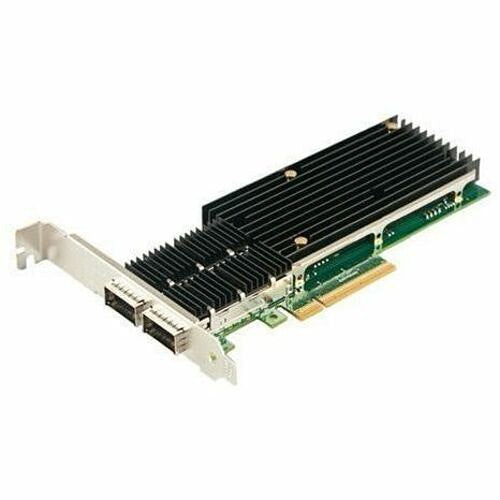
The Axiom 100Gbs Dual Port QSFP28 PCIe 4.0 x16 NIC Card from AXIOM is a high-performance dual-port network adapter built for data centers and enterprise servers that demand fast, reliable 100 Gbps connectivity.
-
Data Rate: 100 Gbps per port (200 Gbps total potential) for bandwidth-hungry applications
-
Ports: 2 x QSFP28 ports to connect to high-speed switches and storage networks
-
Interface: PCIe 4.0 x16 for maximum bus bandwidth; backward compatible with PCIe 3.0 slots (with reduced performance)
-
Brand / Model: AXIOM PCIE4-2QSFP28-AX, PCIE4-2Q28CX6-AX
-
Designed For: High-performance servers, data centers, and enterprise networking gear that require scalable 100G topology
-
RDMA Support: RDMA-capable for low-latency data transfer, improving performance for storage, databases, and HPC workloads
-
Operating System Support: Broad OS compatibility, including Linux and Windows Server environments
-
Connectivity Notes: QSFP28 ports typically require fiber optic cabling to achieve 100G speeds
With this AXIOM NIC, you gain a reliable upgrade path for bandwidth-intensive workloads—think virtualization clusters, high-speed storage networks, AI data pipelines, and HPC applications. RDMA reduces CPU overhead and lowers latency, helping critical applications respond faster while traffic scales. Two independent 100G links also simplify network design, enabling aggregated throughput and easier fault isolation in busy data centers.
Specs
-
Data Rate: 100 Gbps per port
-
Ports: 2 x QSFP28
-
PCIe Version: 4.0 x16 (backward compatible with PCIe 3.0)
-
Brand: AXIOM
-
Model: PCIE4-2QSFP28-AX / PCIE4-2Q28CX6-AX
-
Operating Systems: Linux, Windows Server
-
Connectivity: QSFP28 fiber optic interfaces
-
Is this card compatible with PCIe 3.0 slots? It is designed for PCIe 4.0 but backward compatible with PCIe 3.0 with reduced performance.
-
What cooling solutions are recommended? Adequate airflow or active cooling is advised for optimal operation.
-
Does it support RDMA? Yes, it supports RDMA for low-latency data transfer.
-
What operating systems are supported? Compatible with major server OS including Linux and Windows Server.
-
Is fiber optic cabling required? Yes, QSFP28 ports typically connect via fiber optic cables for 100G speeds.