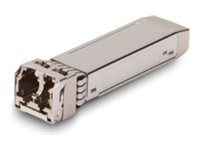
Avago - SFP28 transceiver module - 1GbE - Fibre Channel - LC multi-mode - up to 328 ft - 850 nm
- Compliant to RoHS directives
- 850 nm Vertical Cavity Surface Emitting Laser (VCSEL)
- Class 1 eye safe per IEC60825-1 and CDRH
- Wide temperature range (0°C to 70°C)
- LC duplex connector optical interface
- Real-time monitoring of transmitter average optical power, received average optical power, laser bias current, temperature and supply voltage
Avago Technologies' AFBR-57G5MZ optical transceiver supports high-speed serial links over multi-mode optical fiber at signaling rates up to 28.05 Gb/s. The AFBR-57G5MZ is a multi-rate 850 nm transceiver which features internal clock and data recovery circuits (CDRs) on both electrical input and output.
-
Transmitter section
The transmitter section includes a Transmitter Optical Sub-Assembly (TOSA), laser driver circuit, CDR circuit, and an electrical input stage with variable equalization controls. The TOSA contains an 850 nm VCSEL light source with an integral light-monitoring function and imaging optics to ensure efficient optical coupling to the LC connector interface. The TOSA is driven by a laser driver IC, which uses the differential output from an integral Tx CDR stage to modulate and regulate VCSEL optical power.
-
Receiver section
The receiver section includes a Receiver Optical Sub-Assembly (ROSA), pre-amplification and post-amplification circuit, CDR circuit, and an electrical output stage with variable emphasis controls. The ROSA, containing a high-speed PIN detector, preamplifier, and imaging optics, efficiently couples light from the LC connector interface and performs an optical-to-electrical conversion. The resulting differential electrical signal passes through a post-amplification circuit and into a CDR circuit for cleaning up accumulated jitter.
-
Digital diagnostics
The AFBR-57G5MZ is compliant with the Diagnostic Monitoring Interface (DMI). These features allow the host to access, using two-wire serial, real-time diagnostic monitors of transmit optical power, received optical power, temperature, supply voltage, and laser operating current.
-
Low-speed interfaces
Conventional low-speed interface I/Os are available to manage coarse and fine functions of the optical transceiver.