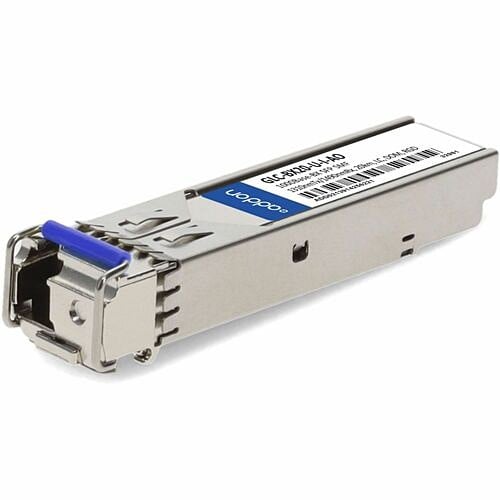
AddOn GLC-BX20-U-I-AO 1000Base-BX SFP Transceiver
The AddOn GLC-BX20-U-I-AO SFP transceiver delivers reliable 1000Base-BX bidirectional connectivity over single-mode fiber for enterprise and carrier-grade networks. This Cisco GLC-BX20-U-I compatible module provides extended reach up to 20 km with separate 1310nm transmit and 1490nm receive wavelengths, making it ideal for long-distance data center interconnects, campus networks, and service provider deployments. Built for demanding environments with an operating temperature range of -40°C to 85°C, integrated digital optical monitoring (DOM), and TAA compliance, this optical transceiver ensures maximum uptime and network visibility across your infrastructure.
Key Features
-
1000Base-BX Bidirectional — Full-duplex 1000 Mbps over single wavelength pair (1310nm Tx/1490nm Rx)
-
20 km Reach — Extended distance connectivity over single-mode fiber for long-haul applications
-
LC Connector Interface — Standard optical interface for seamless integration with existing network infrastructure
-
Digital Optical Monitoring (DOM) — Real-time monitoring of optical power, temperature, and voltage for proactive network management
-
Single-Mode Fiber (SMF) — Optimized for long-distance, low-loss transmission
-
Extended Temperature Range — Operates reliably from -40°C to 85°C in harsh environments
-
TAA Compliant — Meets Trade Agreements Act requirements for government and enterprise procurement
-
Compact Form Factor — SFP design fits dense network environments without additional space requirements
-
Cisco GLC-BX20-U-I Compatible — Drop-in replacement for Cisco original modules at significant cost savings
Technical Specifications
| Specification |
Details |
| Manufacturer |
ADD-ON |
| Part Number |
GLC-BX20-U-I-AO |
| Compatibility |
Cisco GLC-BX20-U-I |
| Protocol |
1000Base-BX |
| Data Rate |
1000 Mbps (1 Gbps) |
| Transmission Type |
Bidirectional (BiDi) |
| Fiber Type |
Single-Mode Fiber (SMF) |
| Transmit Wavelength |
1310 nm |
| Receive Wavelength |
1490 nm |
| Maximum Distance |
20 km |
| Connector Type |
LC |
| Form Factor |
SFP (Small Form-Factor Pluggable) |
| Digital Optical Monitoring |
Yes (DOM) |
| Operating Temperature |
-40°C to 85°C |
| Compliance |
TAA (Trade Agreements Act) |
| Standards |
IEEE 802.3z, ITU-T G.957 |
Frequently Asked Questions
What is the difference between 1000Base-BX and other SFP transceiver types?
1000Base-BX is a bidirectional Gigabit Ethernet standard that transmits and receives data simultaneously over a single strand of single-mode fiber using different wavelengths (1310nm Tx and 1490nm Rx). This differs from 1000Base-SX/LX which use multimode or single-mode fiber with the same wavelength for both directions, requiring two fiber strands. The 1000Base-BX SFP transceiver design reduces cabling complexity and cost while maintaining full-duplex communication.
Is the AddOn GLC-BX20-U-I-AO compatible with Cisco equipment?
Yes, the AddOn GLC-BX20-U-I-AO is fully compatible with Cisco devices that support the GLC-BX20-U-I module, including Catalyst switches, ASR routers, and other Cisco platforms with SFP slots. As a certified Cisco-compatible transceiver, it provides identical performance and reliability as OEM modules while offering significant cost savings.
What does DOM (Digital Optical Monitoring) provide?
Digital Optical Monitoring enables real-time visibility into the optical transceiver's operational status, including received optical power levels, transmitted power, module temperature, and supply voltage. This data allows network administrators to monitor link health, predict failures, and optimize network performance through SNMP-based management tools and network monitoring platforms.
Can this single-mode fiber transceiver work in extreme temperature environments?
Yes, the AddOn GLC-BX20-U-I-AO operates reliably across an extended temperature range from -40°C to 85°C, making it suitable for outdoor installations, industrial environments, and data centers without climate control. This wide temperature tolerance ensures consistent performance in challenging deployment scenarios.