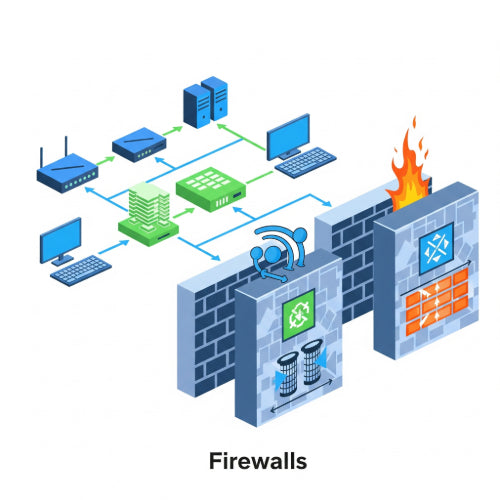
The AI Sentinel: How Artificial Intelligence is Improving Network Security with Firewalls
In an era of increasingly sophisticated cyber threats, traditional network defenses are facing unprecedented challenges. The sheer volume and complexity of attacks, from zero-day exploits to advanced persistent threats (APTs), often overwhelm human security teams and reactive, rule-based systems. This is where Artificial Intelligence (AI) is stepping in, transforming firewalls from static gatekeepers into dynamic, intelligent sentinels capable of defending networks with unprecedented speed and precision.
Firewalls have long been the frontline defense, filtering traffic based on predefined rules. While essential, their limitations against rapidly evolving threats are becoming apparent. AI, particularly machine learning (ML), injects a new level of intelligence, enabling firewalls to learn, adapt, and predict.
Here's how AI is enhancing network security through next-generation firewalls:
1. Advanced Threat Detection: Beyond Signatures
Traditional firewalls primarily rely on signature-based detection – identifying threats by matching them against a database of known malicious patterns. This approach is effective against known threats but falls short against new, never-before-seen (zero-day) attacks.
AI-powered firewalls overcome this limitation by using machine learning algorithms to:
-
Behavioral Analysis: They establish a baseline of "normal" network behavior for users, applications, and devices. Any deviation from this baseline, no matter how subtle, can be flagged as suspicious, indicating a potential threat that doesn't rely on a known signature.
-
Anomaly Detection: AI can analyze vast streams of network traffic in real-time, identifying unusual patterns, sudden spikes in activity, or anomalous data flows that might signal a cyberattack, such as a DDoS attempt or an insider threat.
-
Contextual Understanding: Beyond individual packets, AI can correlate data from various sources – user logs, application behavior, external threat intelligence feeds – to build a more comprehensive picture of a potential threat, reducing false positives and allowing for more accurate threat identification.
2. Proactive Threat Prevention and Predictive Capabilities
AI doesn't just react; it can anticipate. By continuously learning from successful and failed attacks, as well as evolving threat landscapes, AI-powered firewalls can develop predictive capabilities. They can identify emerging attack patterns and proactively adjust firewall rules to block potential threats before they even reach the network perimeter. This shifts the security paradigm from reactive defense to proactive prevention.
3. Automated Incident Response and Mitigation
In the face of a cyberattack, every second counts. AI significantly accelerates incident response:
-
Rapid Containment: Upon detecting a threat, AI-driven firewalls can automatically isolate compromised devices, block malicious IP addresses, or quarantine suspicious traffic segments, preventing the lateral spread of an attack.
-
Automated Remediation: For certain types of known threats, AI can initiate automated remediation actions, such as applying patches or removing malware, freeing up human security analysts for more complex investigations.
-
Reduced Human Workload: By automating routine tasks like threat monitoring, alert triage, and initial response, AI reduces the burden on IT security teams, allowing them to focus on strategic security initiatives and respond to high-priority threats.
4. Continuous Learning and Adaptive Security
The cyber threat landscape is constantly changing. AI's core strength lies in its ability to continuously learn and adapt:
-
Self-Refinement: AI models embedded in firewalls continually refine their detection algorithms based on new data and threat intelligence, ensuring that defenses evolve in real-time to counter emerging attack patterns.
-
Dynamic Policy Enforcement: Instead of static rule sets, AI can enable dynamic firewall policies that automatically adjust based on real-time risk assessments, network topology changes, and user behavior.
5. Enhanced Visibility and Operational Efficiency
AI also brings significant operational benefits:
-
Deeper Insights: AI-powered firewalls can generate comprehensive insights into network traffic, user behaviors, and potential vulnerabilities, providing security teams with a clear, data-driven understanding of their security posture.
-
Simplified Management: By automating threat detection and response, AI simplifies the management of complex firewall deployments, leading to increased operational efficiency and potentially lower costs.
The Future is Intelligent Security
The integration of Artificial Intelligence into network firewalls is not just an upgrade; it's a fundamental shift in how we approach cybersecurity. As cyber threats become more sophisticated and automated, AI-powered firewalls will be an indispensable tool, offering unparalleled capabilities in detection, prevention, and response. They are transforming the firewall into a truly intelligent sentinel, constantly learning and adapting to keep our digital perimeters secure in an ever-evolving threat landscape.
How do you envision AI continuing to transform network security in the coming years?
Search Query: "AI network security firewall evolution"