Server Rack Cabinets vs. Open Frame Racks: Which Is Right for Your Needs?
When setting up or expanding your IT infrastructure, one of the fundamental decisions you'll face is how to house your valuable servers, networking gear, and other equipment. The two primary options are fully enclosed server rack cabinets and open frame racks. While both serve the purpose of organizing hardware, they cater to very different environments and priorities.
Choosing between them isn't just about aesthetics; it's about security, cooling, accessibility, and ultimately, ensuring your equipment operates efficiently and safely. Let's break down the pros and cons of each to help you make the best decision for your specific requirements.
Understanding the Differences
-
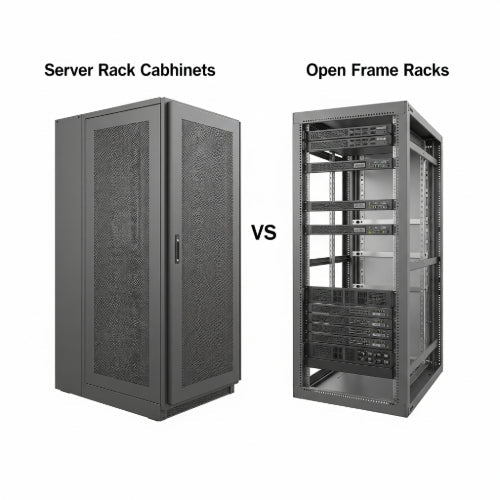
Server Rack Cabinet (Enclosed Rack): These are self-contained, usually floor-standing units with front and rear doors (often perforated for airflow) and side panels. They fully enclose the equipment within, providing a secure and managed environment. They typically come in standard widths (like 19-inch) and varying heights (measured in "U" units).
-
Open Frame Rack: As the name suggests, these racks are open structures, often consisting of two or four vertical posts with mounting rails. They lack doors and side panels, leaving the equipment exposed. They also come in standard widths and U-heights.
Server Rack Cabinets: The Secure & Controlled Environment
Pros:
-
Enhanced Security: This is often the primary reason for choosing a cabinet. Lockable doors and side panels prevent unauthorized physical access, tampering, or theft of equipment.
-
Environmental Protection: Cabinets offer a degree of protection against dust, debris, accidental spills, and even minor physical impacts, which is crucial for sensitive electronics.
-
Optimized Cooling Management: Enclosed cabinets allow for more controlled airflow. With proper planning (e.g., hot aisle/cold aisle containment, specific cooling units), they can direct airflow precisely, leading to more efficient cooling and preventing hot spots. Perforated doors allow for significant airflow while maintaining security.
-
Noise Reduction: While not soundproof, cabinets can help to slightly dampen the noise generated by servers and fans, contributing to a quieter IT environment if the rack is in an office adjacent area.
-
Professional Appearance: A neat, enclosed cabinet presents a very professional and organized look, ideal for data centers, server rooms, or even professional office spaces where equipment might be visible.
-
Cable Management: Many cabinets include built-in cable management features like vertical cable managers, brush strips, and tie-down points, making it easier to keep cables tidy and improve airflow.
Cons:
-
Cost: Cabinets are significantly more expensive than open frame racks due to the additional materials and manufacturing complexity (doors, panels, locks).
-
Weight & Footprint: They are heavier and typically require more floor space, making them less suitable for cramped environments.
-
Accessibility (Initial Setup): While good for security, access can be slightly more cumbersome during initial installation or extensive re-cabling compared to open frames.
-
Heat Buildup (if not managed): Without proper airflow planning and potentially active cooling, heat can build up quickly inside an enclosed cabinet.
Open Frame Racks: The Accessible & Cost-Effective Option
Pros:
-
Cost-Effectiveness: Open frame racks are considerably cheaper to purchase than enclosed cabinets, making them a budget-friendly option for many setups.
-
Maximum Airflow & Cooling: With no doors or side panels, open racks provide unobstructed airflow to all equipment. This is a major advantage for environments where cooling is naturally abundant, or for high-density equipment that generates a lot of heat and benefits from open ventilation.
-
Ease of Accessibility: Equipment is fully exposed, making installation, cabling, maintenance, and troubleshooting incredibly easy and fast. Technicians can access any part of any device without opening doors or removing panels.
-
Simplicity & Portability: They are lighter and simpler in design, often easier to assemble and move (though still heavy when loaded).
-
Ideal for Test Environments: Their accessibility makes them perfect for labs, staging areas, or development environments where hardware is frequently changed or accessed.
Cons:
-
No Physical Security: This is the most significant drawback. Equipment is completely exposed, offering no protection against unauthorized access, theft, or tampering.
-
No Environmental Protection: Equipment is vulnerable to dust, dirt, spills, and accidental bumps or knocks.
-
Noise: There is no sound dampening, meaning the noise from server fans and other equipment is fully audible.
-
Messy Appearance: Without an enclosure, cable management can look chaotic if not diligently maintained, and the overall appearance is less professional.
-
Less Suitable for Production Environments: Due to the lack of security and environmental protection, open frame racks are generally not recommended for mission-critical production environments outside of secure data centers.
Which Is Right for Your Needs?
The best choice hinges on several factors:
-
Security Requirements:
-
High security, preventing unauthorized access? Server Rack Cabinet.
-
Equipment in a highly secure, restricted access room? Open Frame Rack might be acceptable.
-
-
Environment:
-
Dusty, high-traffic area, or risk of spills? Server Rack Cabinet.
-
Clean, climate-controlled, dedicated server room? Open Frame Rack is fine.
-
-
Cooling Needs:
-
Need precise airflow management, hot/cold aisle containment, or active cooling solutions? Server Rack Cabinet.
-
Plenty of ambient cooling, or extremely high-density equipment benefiting from open air? Open Frame Rack.
-
-
Accessibility vs. Security:
-
Prioritize quick, unrestricted access for frequent changes/troubleshooting (e.g., lab, test bench)? Open Frame Rack.
-
Prioritize long-term security and protection for deployed systems? Server Rack Cabinet.
-
-
Budget:
-
Cost is a major constraint for a small setup? Open Frame Rack.
-
Budget allows for better protection and management? Server Rack Cabinet.
-
-
Aesthetics:
-
Needs to look professional and tidy? Server Rack Cabinet.
-
Appearance is not a concern (e.g., hidden closet)? Open Frame Rack.
-
In summary, for most production environments and particularly for sensitive data and critical hardware, a server rack cabinet offers the necessary security, protection, and cooling management. However, for test labs, highly secure data centers with their own robust physical security, or situations where budget and maximum accessibility are paramount, an open frame rack can be an excellent and cost-effective solution. Carefully assess your specific context to make the optimal choice.