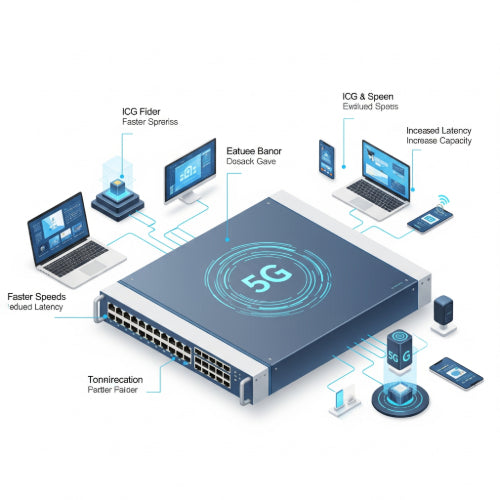
The Unwired Office: How 5G is Set to Revolutionize the Use of Network Switches
For decades, the network switch has been the unsung hero of office connectivity, diligently directing data packets within local area networks (LANs). From connecting PCs and printers to servers and access points, switches have ensured smooth communication. However, with the advent of 5G, the demands on these crucial devices are escalating, pushing them towards a revolutionary transformation.
5G, with its unprecedented speed, ultra-low latency, and massive capacity, isn't just an upgrade; it's a paradigm shift. This shift will fundamentally alter the role and requirements of network switches in office environments.
1. Handling the Deluge of Data: Higher Bandwidth and Throughput
5G promises theoretical speeds up to 20 Gbps and significantly higher average data rates than 4G. This incredible surge in bandwidth means that office networks will be ingesting and transmitting a far greater volume of data.
-
Multi-Gigabit and 100GbE Switches: To keep pace, network switches within offices will need to support higher port speeds. We'll see a broader adoption of multi-gigabit (2.5GbE, 5GbE) and 10GbE switches becoming standard, with 25GbE, 40GbE, and even 100GbE becoming more common for core and distribution layers to handle the aggregated 5G traffic.
-
Reduced Bottlenecks: Enhanced switch capabilities will be essential to prevent bottlenecks, ensuring that the high-speed data coming in from 5G can be efficiently distributed to all connected devices without congestion.
2. The Need for Speed: Ultra-Low Latency Demands
One of 5G's most touted features is its ultra-low latency, sometimes as low as 1 millisecond. This enables real-time applications like augmented reality (AR), virtual reality (VR) for collaboration, real-time analytics, and even localized industrial IoT.
-
Hardware Acceleration: Switches will increasingly incorporate specialized hardware to process packets faster, minimizing delays.
-
Optimized Forwarding Paths: Software-defined networking (SDN) capabilities in switches will allow for dynamic optimization of data paths, ensuring critical, low-latency traffic receives priority.
3. The Explosion of Devices: Massive Connectivity
5G is designed to support millions of connected devices per square kilometer. In an office context, this translates to a massive increase in IoT devices – from smart sensors and lighting to asset trackers and smart appliances.
-
Higher Port Density: Switches will need to offer higher port densities to accommodate the sheer number of connected IoT devices.
-
Power over Ethernet (PoE) Evolution: Enhanced PoE capabilities (e.g., PoE++, 802.3bt) will be crucial to power a wider array of IoT devices directly from the network switch, simplifying deployments and reducing cabling.
-
Micro-segmentation: To manage the diverse traffic from countless IoT devices and enhance security, switches will be central to implementing micro-segmentation, isolating device traffic and limiting potential attack surfaces.
4. Network Slicing and Virtualization: A New Dimension of Control
One of the most revolutionary aspects of 5G is network slicing, which allows multiple virtual networks to run independently on the same physical infrastructure. This has significant implications for how businesses design and manage their internal networks.
-
Software-Defined Networking (SDN) Integration: Switches will be heavily reliant on SDN principles to enable the dynamic creation and management of these virtual network slices. They will need to be programmable and controllable by central orchestrators.
-
Quality of Service (QoS) for Slices: Switches will play a critical role in enforcing QoS policies for each slice, ensuring that different applications (e.g., mission-critical operations vs. guest Wi-Fi) receive the appropriate bandwidth and latency guarantees.
-
Virtual Local Area Networks (VLANs) on Steroids: While VLANs have been used for segmentation, 5G network slicing will demand even more granular and automated segmentation capabilities from switches.
5. Edge Computing: Pushing Intelligence Closer to the Source
5G's low latency makes edge computing highly viable, allowing data processing to occur closer to where data is generated (e.g., within the office network itself, rather than a distant cloud data center).
-
Edge-Optimized Switches: Switches at the "edge" of the office network will need to be robust, secure, and capable of handling local data processing and aggregation before sending relevant data to the cloud.
-
Integrated Compute: Some advanced switches may even integrate limited compute capabilities, becoming "smart edge switches" that can run small applications or perform initial data analytics.
The Evolution of the Switch:
In essence, 5G is transforming network switches from mere data forwarders into intelligent, programmable, and highly adaptable components of a dynamic network infrastructure. They will become more sophisticated, integrating advanced security features, deeper analytics capabilities, and tighter integration with software-defined architectures.
For offices, this means future-proofing their networks, enabling new applications, and supporting a truly agile and efficient workforce. The future of the office network is unwired, intelligent, and powered by a new generation of switches ready to handle the demands of the 5G era.