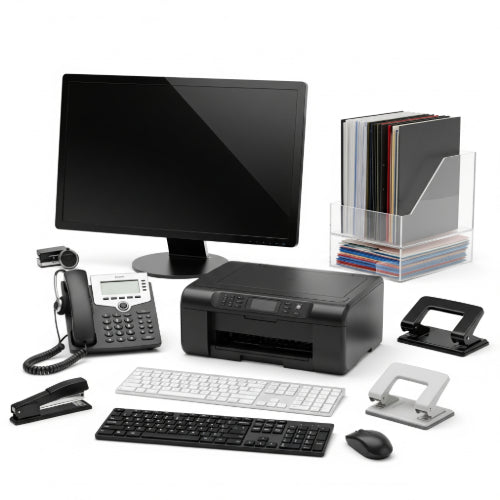
The Untethering of the Office: How 5G Networks Will Reshape Equipment Needs
The promise of 5G has been whispered for years, conjuring images of lightning-fast downloads and seamless streaming. But beyond our personal devices, 5G is poised to profoundly transform the very fabric of our workplaces, especially when it comes to the equipment that fills our offices. This next-generation wireless technology, with its unprecedented speed, low latency, and massive connectivity, won't just improve existing processes; it will redefine what we consider essential office equipment.
Here's how 5G networks will change office equipment needs:
1. The Era of "Wireless First" for Everything
Today, many high-bandwidth office devices – think desktop PCs, large-format printers, and video conferencing systems – still rely heavily on wired Ethernet connections for speed and reliability. 5G's capabilities will largely eliminate this dependency. With multi-gigabit speeds and ultra-low latency, 5G can provide performance on par with, or even exceeding, traditional wired networks.
This means a dramatic reduction in the need for extensive cabling infrastructure within offices. Desks will become truly wireless, allowing for greater flexibility in office layouts and hot-desking environments. Devices like high-definition displays, projectors, and even professional-grade scanners could connect wirelessly, simplifying setups and reducing clutter.
2. Smarter, More Connected Office Devices (IoT at Scale)
5G's ability to connect a massive number of devices simultaneously with minimal power consumption will accelerate the adoption of the Internet of Things (IoT) in the office. We'll see an explosion of smart office equipment:
-
Smart Sensors: Environmental sensors for air quality, temperature, and occupancy can optimize HVAC and lighting systems, leading to energy savings and improved comfort.
-
Intelligent Furniture: Desks that automatically adjust based on user preferences, chairs that monitor posture and suggest breaks, or meeting room tables that intelligently connect to presentations with a touch – all powered by seamless 5G connectivity.
-
Predictive Maintenance: Printers, coffee machines, and other office appliances can self-monitor their health and predict maintenance needs, sending alerts before issues cause downtime. This shifts equipment management from reactive to proactive.
3. Revolutionizing Collaboration and Communication Tools
High-bandwidth and low-latency are the hallmarks of 5G, making it ideal for the next generation of collaboration tools.
-
Advanced Video Conferencing: Expect even higher resolution, more stable multi-participant video calls, making remote interactions feel more natural.
-
Augmented and Virtual Reality (AR/VR): 5G will enable practical applications of AR/VR in the office for remote training, collaborative design reviews (e.g., viewing 3D models together as holograms), and immersive virtual meeting spaces, requiring compatible headsets and powerful, yet portable, computing accessories.
-
Real-time Data Sync: Large files and complex datasets will synchronize almost instantly, regardless of whether team members are in the office, at home, or on the go.
4. Impact on Traditional Hardware: Desktop vs. Thin Client
With ubiquitous high-speed wireless connectivity, the need for powerful, expensive desktop PCs at every workstation might diminish. Employees could increasingly rely on thin clients, laptops, or even tablets that connect to powerful virtual workstations hosted in the cloud or at the edge. The heavy lifting of computing would happen remotely, with 5G ensuring a lag-free experience. This could lead to a significant shift in IT procurement, favoring cloud services and simpler endpoint devices.
5. Edge Computing: Shifting Processing Power
5G often works hand-in-hand with edge computing, where data processing happens closer to the source (e.g., a mini-data center in the office building or a local hub). This reduces the need to send all data back to a central cloud, further minimizing latency and improving the performance of local applications and devices. Office equipment might incorporate more edge-processing capabilities, making them smarter and more autonomous.
The Untethered Future is Here
The transition to 5G-powered offices won't happen overnight, but the trajectory is clear. Offices in Daet, Bicol, Philippines, and around the world will become more agile, efficient, and intelligent. The equipment within them will be less about raw processing power packed into a box and more about seamless connectivity, smart functionality, and an enhanced user experience, all driven by the transformative capabilities of 5G networks. Businesses that embrace this shift will be better positioned to support flexible work models, optimize operations, and stay competitive in an increasingly connected world.