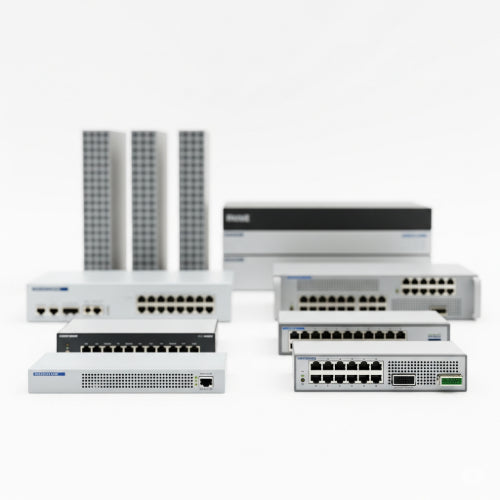
The Intelligent Network: How AI is Reshaping the Future of Switches and Firewalls
Our networks are growing exponentially in complexity, supporting everything from remote work and cloud applications to IoT devices and massive data transfers. Managing this intricate web manually is becoming increasingly challenging, if not impossible. Enter Artificial Intelligence (AI) – a game-changer that is fundamentally transforming how network switches and firewalls operate, manage, and secure our digital infrastructure.
AI isn't just a buzzword in networking; it's becoming the brain behind a more intelligent, resilient, and proactive network. Here's how AI is changing the future of network switches and firewalls:
1. AI-Powered Network Switches: Smarter Traffic Management
Traditional network switches perform their duties based on predefined rules and learned MAC addresses. AI elevates this by introducing predictive analytics and automated optimization.
- Proactive Performance Optimization: AI can analyze traffic patterns in real-time, predict congestion before it occurs, and dynamically re-route traffic or adjust bandwidth allocation to ensure optimal performance for critical applications. This moves beyond static QoS policies to dynamic, adaptive management.
- Anomaly Detection: AI algorithms can learn "normal" network behavior. Any deviation from this baseline, such as unusual traffic spikes, unexpected device connections, or abnormal data flows, can be flagged as a potential anomaly or threat, often before human administrators even notice.
- Automated Troubleshooting: When issues arise (e.g., a port suddenly experiences high error rates), AI can analyze logs, correlate events, and even suggest or automatically implement troubleshooting steps, significantly reducing mean time to resolution.
- Predictive Maintenance: AI can monitor the health of switch hardware, predicting potential failures (e.g., a fan about to fail, a power supply showing instability) and alerting administrators for proactive replacement, preventing unexpected downtime.
2. AI in Firewalls: The Next Generation of Security
Firewalls are on the front lines of cybersecurity, and AI is dramatically enhancing their ability to detect and mitigate threats.
- Advanced Threat Detection: Traditional firewalls rely on signature-based detection. AI-powered firewalls go further by using machine learning to identify polymorphic malware, zero-day attacks, and sophisticated phishing attempts by analyzing behavioral patterns and anomalies in network traffic. They can detect threats that don't match known signatures.
- Adaptive Security Policies: Instead of static rule sets, AI can learn from observed traffic and threat intelligence to automatically adapt firewall policies in real-time. For instance, if a new threat emerges, the firewall can instantly update its blocking rules across the network.
- Automated Incident Response: When a threat is detected, AI can trigger automated responses, such as isolating infected devices, blocking malicious IP addresses, or quarantining suspicious files, minimizing the damage from an attack.
- User and Entity Behavior Analytics (UEBA): AI can profile the normal behavior of users and devices on the network. If an account suddenly tries to access unusual resources or transfers an anomalous amount of data, the AI can flag it as potentially compromised, even if the user's credentials were stolen.
- Reduced False Positives: By continuously learning and refining its models, AI helps firewalls become more accurate in identifying genuine threats, reducing the number of false positives that can overwhelm security teams.
3. The Convergence: AI-Driven Network & Security Operations
The biggest impact of AI will be in blurring the lines between network operations (NetOps) and security operations (SecOps).
- Unified Visibility: AI platforms can provide a single pane of glass view across both network performance and security posture, identifying how network issues might be linked to security incidents and vice-versa.
- Orchestration and Automation: AI will enable higher levels of automation, allowing network and security configurations to be dynamically adjusted based on real-time threats or performance demands, without manual intervention.
- Self-Healing Networks: The ultimate vision is a "self-healing" network where AI can detect, diagnose, and remediate issues (both performance and security-related) autonomously, ensuring continuous operation.
Challenges and the Road Ahead:
While the potential is immense, challenges remain. These include the need for massive datasets for AI training, ensuring data privacy, managing the complexity of AI models, and the ongoing battle against increasingly sophisticated AI-powered cyberattacks.
However, the trajectory is clear: AI is not just optimizing; it's revolutionizing network switches and firewalls. Businesses that embrace this intelligent evolution will build more secure, efficient, and resilient networks, ready to handle the demands of tomorrow's digital landscape.