Bridging the Gap: The Growing Demand for Media Converters in Modern Networks
In today's rapidly evolving networking landscape, the need for seamless connectivity and efficient data transmission is paramount. While fiber optic technology offers numerous advantages in terms of speed and distance, the reality is that most networks are still a heterogeneous mix of copper and fiber infrastructure. This is where media converters play a crucial, and increasingly vital, role.
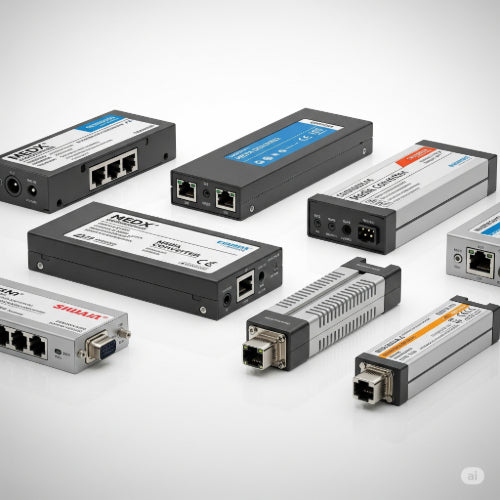
Media converters, simple yet powerful devices, act as translators between different types of network media, most commonly converting copper-based Ethernet signals to fiber optic and vice versa. Their growing demand reflects the practical challenges and evolving needs of modern networks across various industries and applications.
Why the Increased Demand?
Several key factors are driving the rising popularity of media converters:
1. Extending Network Reach with Fiber Optics:
Fiber optic cables offer significantly longer transmission distances compared to copper cables without signal degradation. This makes them ideal for connecting buildings within a campus, extending networks across large facilities, or linking geographically separated locations. Media converters enable organizations to leverage the benefits of fiber optics where needed, even if their existing infrastructure is primarily copper-based, without requiring a complete and costly overhaul.
2. Upgrading Network Speed and Bandwidth:
As bandwidth demands continue to skyrocket due to data-intensive applications, cloud services, and increased user activity, fiber optics provides the necessary capacity. Media converters allow businesses to selectively upgrade critical network segments to fiber, boosting speed and bandwidth where it matters most, while still utilizing their existing copper infrastructure for other connections.
3. Enhancing Network Reliability and Security:
Fiber optic cables are immune to electromagnetic interference (EMI) and radio frequency interference (RFI), which can disrupt copper-based transmissions. This inherent immunity makes fiber more reliable, especially in environments with significant electrical noise. Furthermore, fiber is more secure as it is much harder to tap into without being physically detected. Media converters facilitate the integration of fiber segments into networks, improving overall reliability and security.
4. Cost-Effective Network Expansion and Upgrades:
Replacing an entire copper-based network with fiber can be prohibitively expensive. Media converters offer a more cost-effective approach by allowing organizations to strategically implement fiber where its benefits are most needed. This phased approach to network upgrades helps manage budgets and minimizes disruption to existing operations.
5. Supporting Diverse Network Topologies:
Modern networks often involve a mix of different physical layer technologies. Media converters provide the flexibility to connect disparate network segments seamlessly, regardless of whether they utilize copper (various categories of Ethernet) or fiber (single-mode or multi-mode with different connector types like LC, SC, etc.). This adaptability is essential for building and maintaining complex network topologies.
6. Power over Ethernet (PoE) Considerations:
Many modern devices, such as IP cameras, VoIP phones, and wireless access points, utilize Power over Ethernet (PoE). Media converters are available with PoE capabilities, allowing network administrators to extend both data and power over copper connections and then seamlessly transition to fiber for longer distances or improved reliability, all while still providing power to the end device.
7. Industrial and Harsh Environments:
In industrial settings and other harsh environments, fiber optics' resistance to EMI, vibration, and extreme temperatures makes it a preferred medium. Industrial-grade media converters are designed to withstand these challenging conditions, enabling reliable data transmission in factories, transportation systems, and outdoor deployments.
Looking Ahead:
As network demands continue to grow and the adoption of fiber optic technology expands, the demand for media converters is only expected to increase. They provide a crucial bridge between existing and emerging network infrastructure, offering a flexible, cost-effective, and reliable solution for organizations of all sizes. Whether it's extending network reach, boosting bandwidth, enhancing reliability, or facilitating phased upgrades, media converters are indispensable tools for building and maintaining the modern networks that power our connected world.