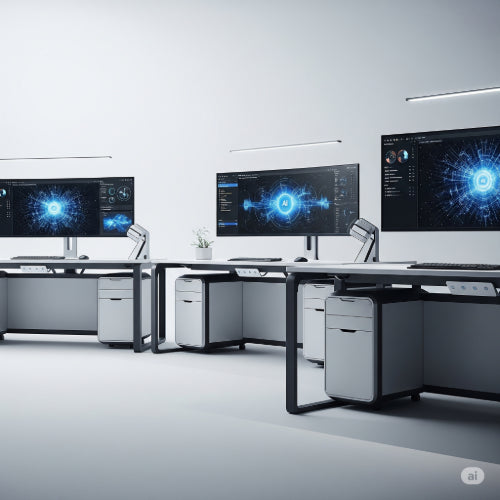
Beyond the Desktop: How AI-Powered Workstations Are Transforming Business Productivity
The traditional workstation, a powerful but static machine, is rapidly evolving. With the integration of Artificial Intelligence (AI) capabilities, these workhorses are no longer just tools for processing data; they are becoming intelligent partners, fundamentally reshaping how businesses operate and boosting productivity to unprecedented levels.
This isn't about science fiction anymore; AI-powered workstations are a tangible reality, delivering significant advantages across various industries. Here's how they're transforming business productivity:
1. Accelerated Performance for Demanding Tasks:
AI-powered workstations go beyond raw processing power. They often incorporate specialized hardware like Neural Processing Units (NPUs) alongside traditional CPUs and GPUs. This dedicated AI acceleration allows for:
-
Real-time Data Analysis: Processing massive datasets, identifying patterns, and generating actionable insights in minutes, not hours, for fields like finance, healthcare, and retail.
-
Faster Content Creation: From accelerated graphics rendering for 3D animation and visual effects to AI-assisted content generation and enhanced video editing, creative professionals can produce high-quality work much more quickly.
-
Complex Simulations and Modeling: Industries like engineering and automotive benefit from faster simulations and testing, leading to quicker product development and innovation.
2. Intelligent Automation and Streamlined Workflows:
One of the most impactful ways AI workstations boost productivity is through intelligent automation. They take repetitive, time-consuming tasks off human hands, freeing up employees for more strategic and creative work.
-
Automated Data Entry and Processing: AI can rapidly process invoices, manage inventory, and handle other data-intensive tasks with increased accuracy and speed.
-
Smart Document Management: AI can classify documents, extract relevant information, and even summarize large texts, making information retrieval and review far more efficient.
-
Virtual Assistants and Task Management: AI can handle routine activities like scheduling meetings, sorting emails, and setting reminders, integrating seamlessly with existing workflows.
3. Enhanced Decision-Making and Insights:
AI's ability to analyze vast amounts of data is a game-changer for informed decision-making.
-
Predictive Analytics: AI can forecast market trends, predict demand, and optimize supply chains by identifying subtle patterns that human analysts might miss.
-
Risk Assessment: In industries like finance, AI workstations can rapidly analyze billions of data points to detect fraudulent activity with high accuracy, enhancing security and compliance.
-
Personalized Recommendations: AI can analyze customer behavior to provide tailored product recommendations and marketing strategies, leading to improved customer engagement and revenue.
4. Improved Collaboration and Communication:
Modern AI workstations are also making collaboration more seamless, especially in a hybrid work environment.
-
AI-Enhanced Video Conferencing: Features like automatic noise cancellation, intelligent background adjustments, and real-time transcription ensure clearer and more productive virtual meetings.
-
Language Translation: Real-time language translation facilitates communication between international teams, breaking down geographical barriers.
-
Smart Scheduling: AI-powered assistants can coordinate meetings across different time zones, simplifying logistics for distributed teams.
5. Future-Proofing Your Business:
Investing in AI-powered workstations isn't just about current gains; it's about building a future-ready infrastructure. These systems are designed to continuously learn and improve, adapting to evolving demands and technologies. This self-training capability makes them a long-term investment that offers exceptional returns.
In essence, AI-powered workstations are more than just an upgrade; they are a fundamental shift in how businesses leverage technology to empower their workforce. By offloading mundane tasks, providing deeper insights, and fostering smarter collaboration, they are unlocking new levels of productivity and paving the way for unprecedented innovation in the business world. The future of work is here, and it's powered by AI.