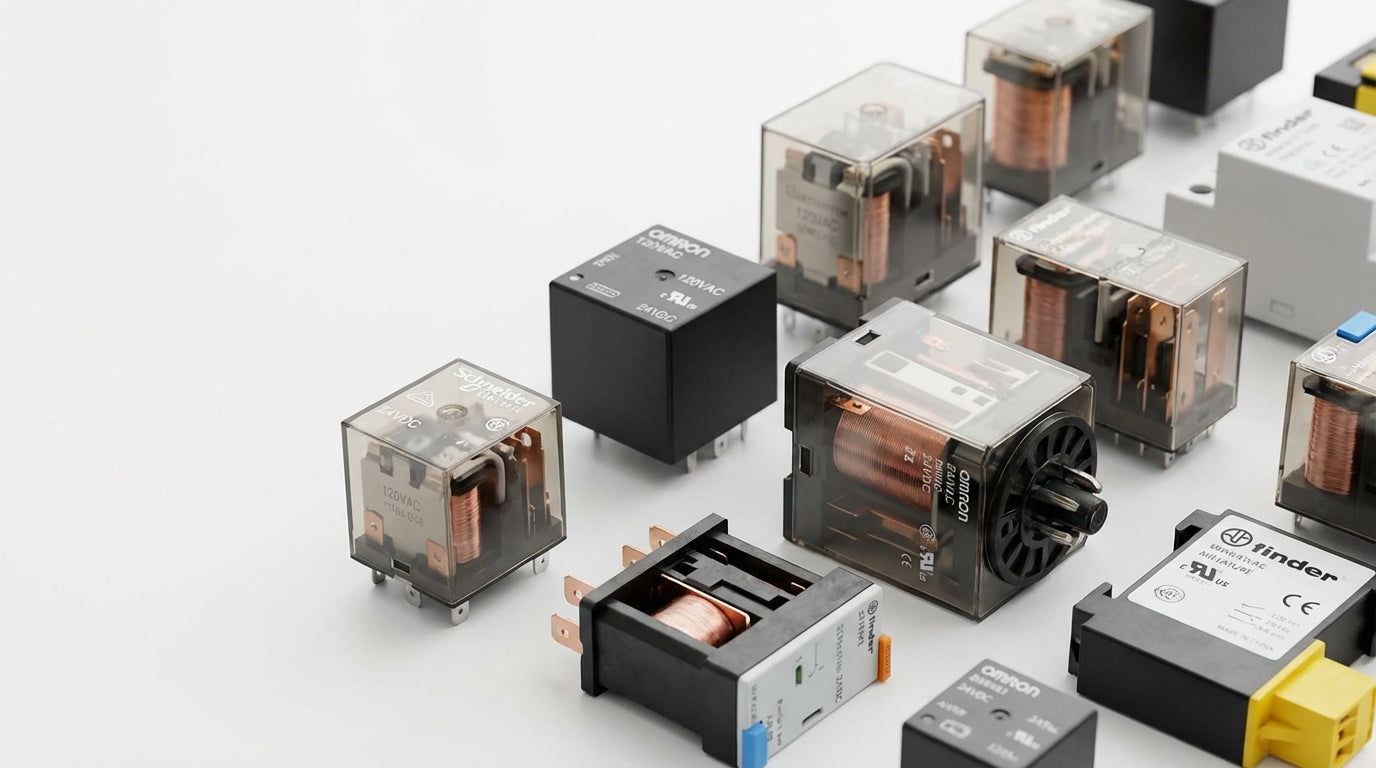
Electrical Relays Buying Guide: How to Choose the Right Type
Understanding Electrical Relays for Industrial and Commercial Applications
Electrical relays are essential switching devices that control high-power circuits using low-power signals. Whether you're designing automation systems, protecting electrical equipment, or building control panels, choosing the right relay can mean the difference between reliable operation and costly failures.
With dozens of relay types available—from basic electromechanical units to specialized solid-state and protective relays—buyers often struggle to match the right technology to their specific needs. This guide breaks down the key relay families, critical selection criteria, and practical decision frameworks to help you choose confidently.
At Tecisoft, we supply a comprehensive range of electrical relays for industrial automation, commercial buildings, and specialized applications across North America.
Key Types of Electrical Relays
Electromechanical Relays (EMR)
Electromechanical relays use a coil, armature, and mechanical contacts to switch circuits. They remain the most widely used relay type for general industrial and commercial control.
Key advantages:
- Low cost and widely available
- Multiple contact configurations (SPDT, DPDT, etc.)
- Handle both AC and DC loads effectively
- Visible operation status and audible click
- Easy field replacement
Common subtypes:
- General-purpose relays: Plug-in units for panels and control circuits
- Machine-tool relays: Robust NEMA/IEC style for harsh industrial environments
- Power relays: Higher current ratings for motors, heaters, and large loads
Solid-State Relays (SSR)
Solid-state relays use semiconductor switching (triacs, thyristors, MOSFETs) with no moving parts. They excel in applications requiring fast switching or long service life.
Key advantages:
- Silent operation with no mechanical wear
- Extremely fast switching speeds
- Long operational life (millions of cycles)
- Excellent for microcontroller interfaces
- No contact bounce or arcing
Important considerations:
- Higher initial cost than EMR
- Generate heat requiring proper thermal management
- Can fail in shorted condition
- Limited to specific load types
Reed Relays
Reed relays feature magnetically actuated contacts sealed in glass tubes. They're ideal for low-power signal switching and measurement applications.
Key advantages:
- Very small size and light weight
- Fast switching with long mechanical life
- Hermetically sealed contacts
- Low contact resistance
- Excellent for dry circuits and signal levels
Typical applications:
- Test and measurement equipment
- Telecommunications systems
- Medical devices
- RF and high-frequency circuits
Protective Relays
Protective relays monitor electrical conditions and trip circuit breakers to protect power systems and equipment. They're essential in industrial facilities, utilities, and large commercial buildings.
Common types:
- Overcurrent and overvoltage protection
- Differential relays for transformers
- Distance relays for transmission lines
- Motor protection relays
Critical Selection Criteria
Load Characteristics
Your switching requirements drive relay selection more than any other factor.
Load type considerations:
- Resistive loads (heaters, lighting): Generally easiest to switch
- Inductive loads (motors, solenoids): Create high inrush currents and back-EMF
- Capacitive loads (power supplies): High initial charging current
- Lamp loads: Extreme inrush current (10-15x steady state)
Voltage and current ratings:
- Size contacts for maximum steady-state current plus safety margin
- Account for inrush currents that can be 5-15x normal operating current
- Verify AC vs DC ratings match your application
- Consider breaking capacity for fault conditions
Control Circuit Requirements
Coil specifications:
- Match coil voltage to available control power (5V, 12V, 24V DC common for PLC outputs)
- Consider coil power consumption for battery or low-power systems
- Verify isolation requirements between control and load circuits
Operating Environment
Temperature and environmental factors:
- Standard relays: typically -40°C to +85°C
- High-temperature applications may require specialized units
- Vibration and shock resistance for mobile or industrial equipment
- Sealed relays for contaminated or corrosive environments
Switching Speed and Frequency
Application-specific requirements:
- High-speed switching: SSR or reed relays (microseconds to milliseconds)
- Standard control: EMR adequate (5-10 milliseconds typical)
- High-duty cycle: SSR preferred to avoid contact wear
- Infrequent switching: EMR often most cost-effective
Choosing the Right Relay Type by Application
General Industrial Automation
Best choice: General-purpose or machine-tool EMR
Selection checklist:
- Determine load current and voltage requirements
- Choose appropriate contact configuration (SPDT, DPDT, etc.)
- Select coil voltage matching control system
- Verify environmental ratings
- Consider DIN-rail or panel mounting options
High-Speed or Frequent Switching
Best choice: Solid-state relays
Key considerations:
- Size SSR for 150-200% of maximum load current
- Plan for adequate heat sinking
- Use input protection for control circuits
- Consider zero-crossing vs random switching for AC loads
Signal and Measurement Circuits
Best choice: Reed relays
Critical factors:
- Minimize thermal EMF for precision measurements
- Consider contact resistance specifications
- Verify isolation and crosstalk requirements
- Match switching speed to signal requirements
Safety and Emergency Stop Circuits
Best choice: Force-guided (safety) relays
Required features:
- Mechanically linked contacts prevent dangerous failures
- Meet relevant safety standards (ISO 13849, IEC 62061)
- Redundant contact monitoring
- Positive opening action
Frequently Asked Questions
Q: When should I use solid-state relays instead of electromechanical relays?
Choose SSRs when you need silent operation, very long life, or switching speeds faster than 10ms. They're ideal for temperature control, lighting dimmers, and high-frequency switching. Stick with EMR for general control where cost matters more than speed.
Q: How do I size relay contacts for motor loads?
Size contacts for at least 125% of motor full-load current, but check the relay's motor rating specifically. Motor starting current can be 6-8x running current. Many relay manufacturers provide separate "motor ratings" that account for inductive switching challenges.
Q: What's the difference between AC and DC relay ratings?
DC is harder to interrupt than AC because DC doesn't naturally cross zero. A relay rated for 10A at 250V AC might only handle 5A at 24V DC. Always verify the rating matches your circuit type and voltage level.
Q: Can I use automotive relays in industrial applications?
Automotive relays can work for some industrial uses but may lack the environmental ratings, contact options, or mounting styles needed. Industrial-rated relays typically offer better vibration resistance, wider temperature ranges, and standardized mounting.
Q: How do I prevent relay contact welding?
Use appropriately sized contacts, add surge suppressors for inductive loads, and consider current-limiting devices. For critical applications, use force-guided relays or add auxiliary contacts to monitor main contact status.
Q: What maintenance do relays typically require?
EMRs may need eventual replacement due to contact wear, especially on high-cycle or difficult loads. SSRs typically require no maintenance but should be monitored for heat-related degradation. Keep relay enclosures clean and check mounting torque periodically.
Making Your Final Selection
Successful relay selection starts with understanding your load requirements and operating conditions. Focus on these key decision points:
- Characterize your load: type, voltage, current, and switching frequency
- Match control requirements: coil voltage, power consumption, and isolation needs
- Consider environment: temperature, vibration, contamination, and mounting constraints
- Evaluate lifecycle costs: initial price, maintenance needs, and replacement frequency
- Verify standards compliance: safety, environmental, and industry-specific requirements
Next steps checklist:
- Calculate maximum load current including inrush
- List required contact configurations
- Identify environmental and mounting constraints
- Compare 2-3 relay options from different technologies
- Review manufacturer specifications and application notes
Ready to find the right electrical relays for your project? Browse our comprehensive electrical relays range at Tecisoft, where our technical team can help match relay specifications to your exact application requirements.
Ready to find the right solutions for your needs?
Explore Collection